
The Trump Effect: How Presidential Policies Are Reshaping the Cryptocurrency Landscape
The Trump Effect: How Presidential Policies Are Reshaping the Cryptocurrency Landscape
In recent months, the cryptocurrency market has experienced significant shifts due to the policies and announcements of President Donald Trump. His administration’s approach to digital assets has created new opportunities and challenges for investors and market participants. This comprehensive analysis examines how Trump’s policies are influencing the cryptocurrency landscape and identifies five promising cryptocurrencies that may benefit from these developments.
Trump’s Cryptocurrency Strategy: Creating a Digital Fort Knox
On March 6, 2025, President Donald Trump signed an Executive Order establishing a Strategic Bitcoin Reserve and a U.S. Digital Asset Stockpile, positioning the United States as a leader among nations in government digital asset strategy. This groundbreaking initiative represents a significant shift from previous administrations’ approaches to cryptocurrency regulation.
The Strategic Bitcoin Reserve treats bitcoin as a reserve asset, similar to gold, and will be capitalized with bitcoin owned by the Department of Treasury that was forfeited through criminal or civil asset forfeiture proceedings. Importantly, the United States has committed not to sell bitcoin deposited into this reserve, maintaining it as a store of value for the long term.
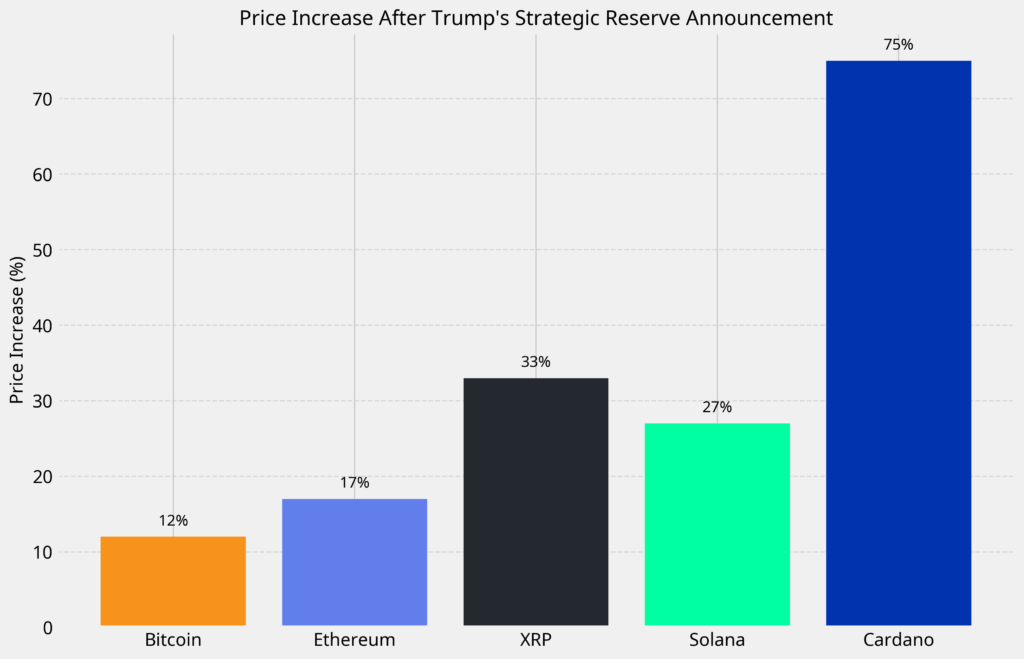
In addition to the Bitcoin reserve, Trump established a U.S. Digital Asset Stockpile consisting of digital assets other than bitcoin. On March 2, 2025, Trump specifically named four additional cryptocurrencies to be included in this stockpile: Ethereum, XRP, Solana, and Cardano. This announcement triggered immediate market reactions, with some of these assets experiencing price increases of up to 75% within 24 hours.
Trump’s cryptocurrency strategy extends beyond asset accumulation. On April 10, 2025, he signed legislation to nullify expanded IRS crypto broker rules, reducing regulatory burdens on the industry. His January 23, 2025 Executive Order on “Strengthening American Leadership in Digital Financial Technology” established five high-level policy objectives:
- Protecting the lawful use of blockchain networks, participation in mining and validation, and self-custody of digital assets
- Promoting dollar-backed stablecoins
- Ensuring fair and open access to banking services
- Providing regulatory clarity for digital assets
- Prohibiting Central Bank Digital Currencies (CBDCs)
The Securities and Exchange Commission (SEC) has also shifted its approach under Trump’s direction, launching a crypto task force dedicated to developing a comprehensive and clear regulatory framework for crypto assets. This represents a departure from the previous administration’s enforcement-focused approach.
Five Promising Cryptocurrencies in the Trump Era
Based on Trump’s policies and market developments, the following five cryptocurrencies show particular promise:
1. Bitcoin (BTC)
Bitcoin holds a unique position in Trump’s cryptocurrency strategy as the cornerstone of the Strategic Bitcoin Reserve. Described as a “digital Fort Knox,” this designation places Bitcoin in a category of its own among digital assets.
Current Market Position:
- Market Capitalization: $1.9 trillion (April 2025)
- Price: Approximately $80,000 per coin
- Market Dominance: 59.7% of total cryptocurrency market
Price Performance:
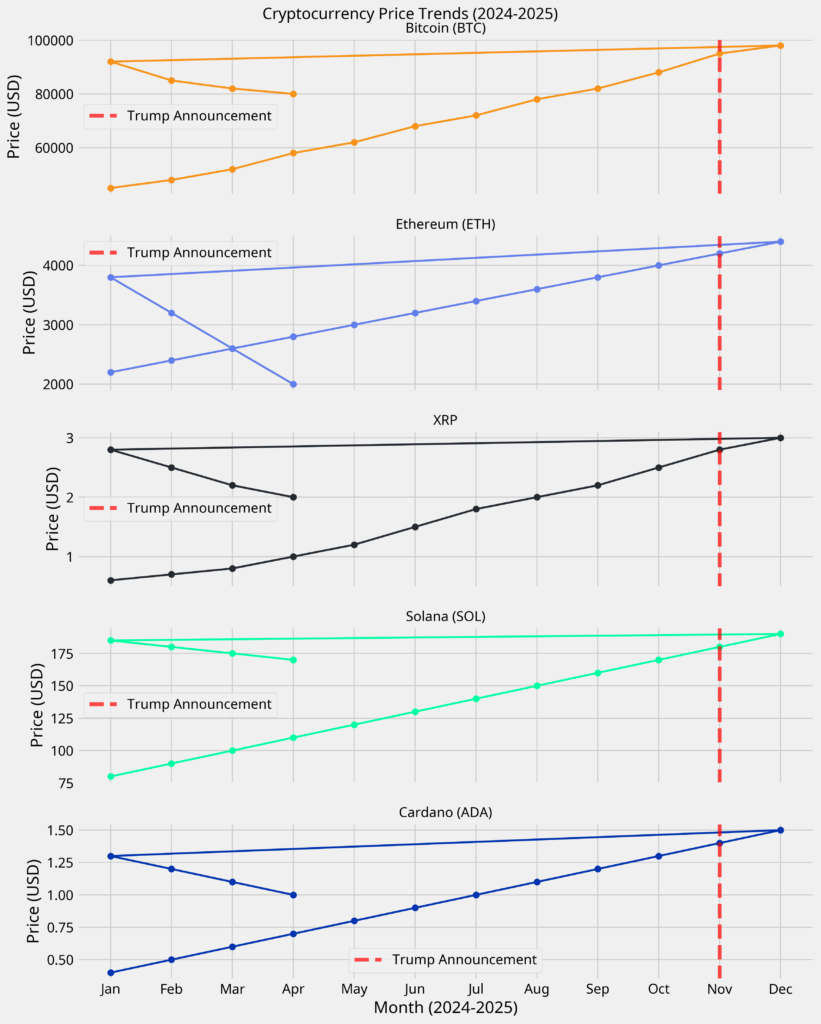
Bitcoin surged from approximately $45,000 in January 2024 to over $80,000 in April 2025, with a notable spike following Trump’s Strategic Reserve announcement. The price increased by 12% immediately after Trump’s announcement, demonstrating the market’s positive reaction to this policy.
Key Strengths:
- First-mover advantage and strongest brand recognition
- Limited supply of 21 million coins creates scarcity
- Increasingly viewed as “digital gold” and a hedge against inflation
- Institutional adoption accelerating through ETFs and corporate treasury investments
- Unique governmental backing through the Strategic Bitcoin Reserve
Challenges:
- Extreme price volatility (from $68,000 in October 2021 to $17,000 in October 2022)
- Limited transaction throughput (7 transactions per second)
- Higher energy consumption compared to newer cryptocurrencies
- Primarily a store of value rather than a practical payment system for everyday transactions
2. Ethereum (ETH)
Ethereum, the second-largest cryptocurrency by market capitalization, is included in the U.S. Digital Asset Stockpile and continues to be the leading platform for smart contracts and decentralized applications.
Current Market Position:
- Market Capitalization: $300 billion (April 2025)
- Price: Approximately $2,000 per coin
- Transaction Speed: 30 transactions per second
Price Performance:
Ethereum experienced significant volatility, reaching over $4,000 in late 2024 before declining to around $2,000 in April 2025. Despite this volatility, it saw a 17% price increase following Trump’s announcement of its inclusion in the Digital Asset Stockpile.
Key Strengths:
- Leading platform for smart contracts and decentralized applications
- Transition to Proof of Stake in 2022 reduced energy consumption by 99.95%
- Robust developer community continuously improving the platform
- Extensive ecosystem of DeFi applications, NFTs, and other blockchain innovations
- Strong institutional backing and growing enterprise adoption
Challenges:
- Network congestion during high demand periods
- Volatile gas fees ranging from $1 to $50 during peak usage
- Competition from faster and cheaper blockchains
- Complex upgrade path that can introduce technical risks
- Price volatility affecting usability for everyday transactions
3. XRP (Ripple)
XRP, developed by Ripple, has gained significant attention following its inclusion in Trump’s Digital Asset Stockpile. Its focus on cross-border payments aligns with the administration’s interest in maintaining U.S. financial leadership.
Current Market Position:
- Market Capitalization: $170 billion (April 2025)
- Price: Approximately $2.00 per coin
- Transaction Speed: 1,500 transactions per second
Price Performance:
XRP experienced a dramatic 33% price increase following Trump’s announcement, with trading volumes increasing by 500%. This strong performance reflects the market’s positive reaction to its inclusion in the U.S. Digital Asset Stockpile.
Key Strengths:
- Exceptional transaction speed and scalability
- Strong partnerships with major financial institutions worldwide
- Low transaction costs make it ideal for cross-border payments
- Regulatory clarity in various countries
- Inclusion in the U.S. Digital Asset Stockpile enhances legitimacy
Challenges:
- Centralization concerns as Ripple maintains significant control
- Historical legal challenges from regulatory bodies
- Competition from both traditional financial systems and other cryptocurrencies
- Limited use cases beyond cross-border payments
- Perception issues among cryptocurrency purists who value decentralization
4. Solana (SOL)
Solana has emerged as one of the fastest blockchains in the cryptocurrency ecosystem and has been specifically named by Trump for inclusion in the Digital Asset Stockpile.
Current Market Position:
- Market Capitalization: $90 billion (April 2025)
- Price: Approximately $170 per coin
- Transaction Speed: 65,000 transactions per second
Price Performance:
Solana saw a 27% price increase following Trump’s announcement, with trading volumes increasing by 350%. Its price has shown strong resilience, maintaining most of these gains in the following months.
Key Strengths:
- Exceptional transaction speed and throughput
- Low transaction fees averaging $0.02 per transaction
- Growing ecosystem with over 440 decentralized applications
- Energy-efficient consensus mechanism
- Strong developer and investor community support
Challenges:
- Network reliability issues with occasional outages
- Centralization concerns due to high validator requirements
- Intense competition from Ethereum and other smart contract platforms
- Technical complexity creating barriers to adoption
- Security concerns as a high-profile target
5. Cardano (ADA)
Cardano, with its research-driven approach to blockchain development, rounds out the five cryptocurrencies specifically named by Trump for the Digital Asset Stockpile.
Current Market Position:
- Market Capitalization: $40 billion (April 2025)
- Price: Approximately $1.00 per coin
- Transaction Speed: 250 transactions per second
Price Performance:
Cardano experienced the most dramatic price movement following Trump’s announcement, with a remarkable 75% increase and trading volumes surging by 1,450%. This exceptional performance highlights the market’s strong reaction to its inclusion in the U.S. Digital Asset Stockpile.
Key Strengths:
- Energy-efficient Proof of Stake consensus mechanism
- Research-driven development with peer-reviewed updates
- Fixed supply creating potential scarcity value
- Strategic partnerships with financial institutions and governments
- Ongoing development of advanced scaling solutions
Challenges:
- Slower development pace compared to competitors
- Lagging ecosystem development despite strong fundamentals
- Historical congestion issues during peak usage
- Adoption challenges despite technical merits
- Market volatility affecting short-term investment potential
Comparative Analysis
When comparing these five cryptocurrencies across key metrics, several patterns emerge:
Market Capitalization
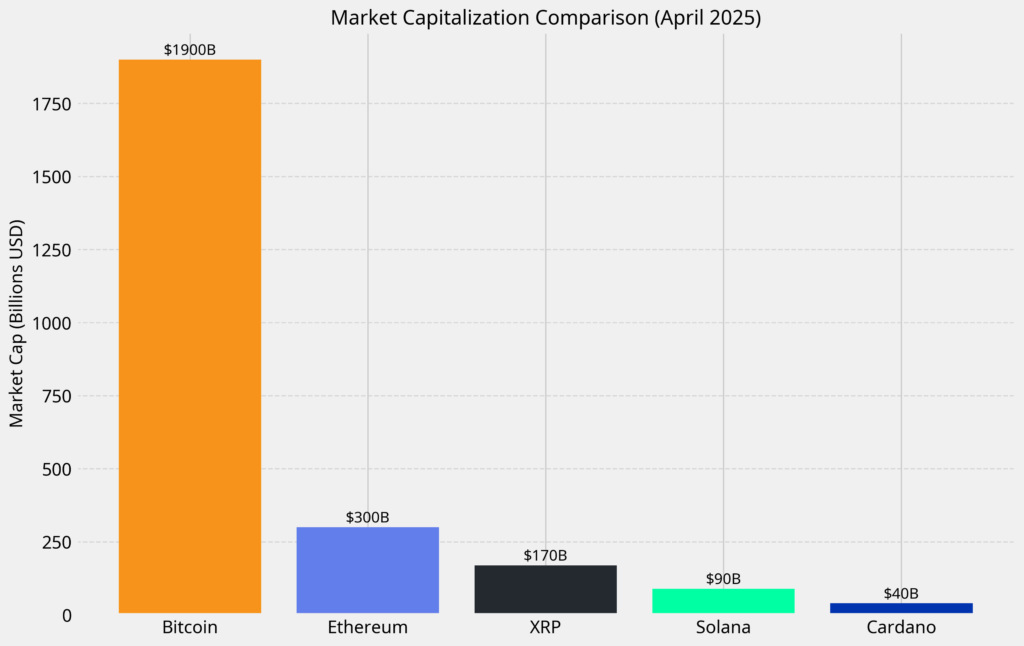
Bitcoin dominates with a $1.9 trillion market cap, followed by Ethereum ($300 billion), XRP ($170 billion), Solana ($90 billion), and Cardano ($40 billion). This distribution reflects Bitcoin’s continued dominance as the primary cryptocurrency investment.
Transaction Speed
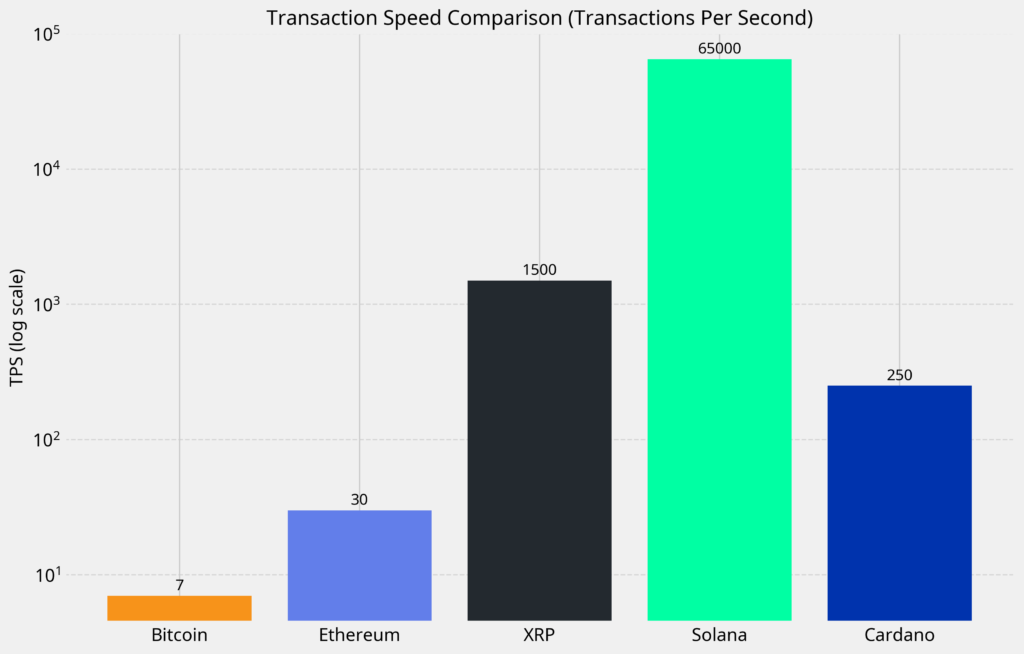
Solana leads by a significant margin with 65,000 transactions per second, followed by XRP (1,500), Cardano (250), Ethereum (30), and Bitcoin (7). This performance gap highlights the technical advantages of newer blockchain architectures.
Price Impact from Trump’s Announcement
Cardano experienced the most dramatic price increase (75%), followed by XRP (33%), Solana (27%), Ethereum (17%), and Bitcoin (12%). Interestingly, the smaller market cap cryptocurrencies generally saw larger percentage gains, suggesting greater sensitivity to policy changes.
Feature Comparison
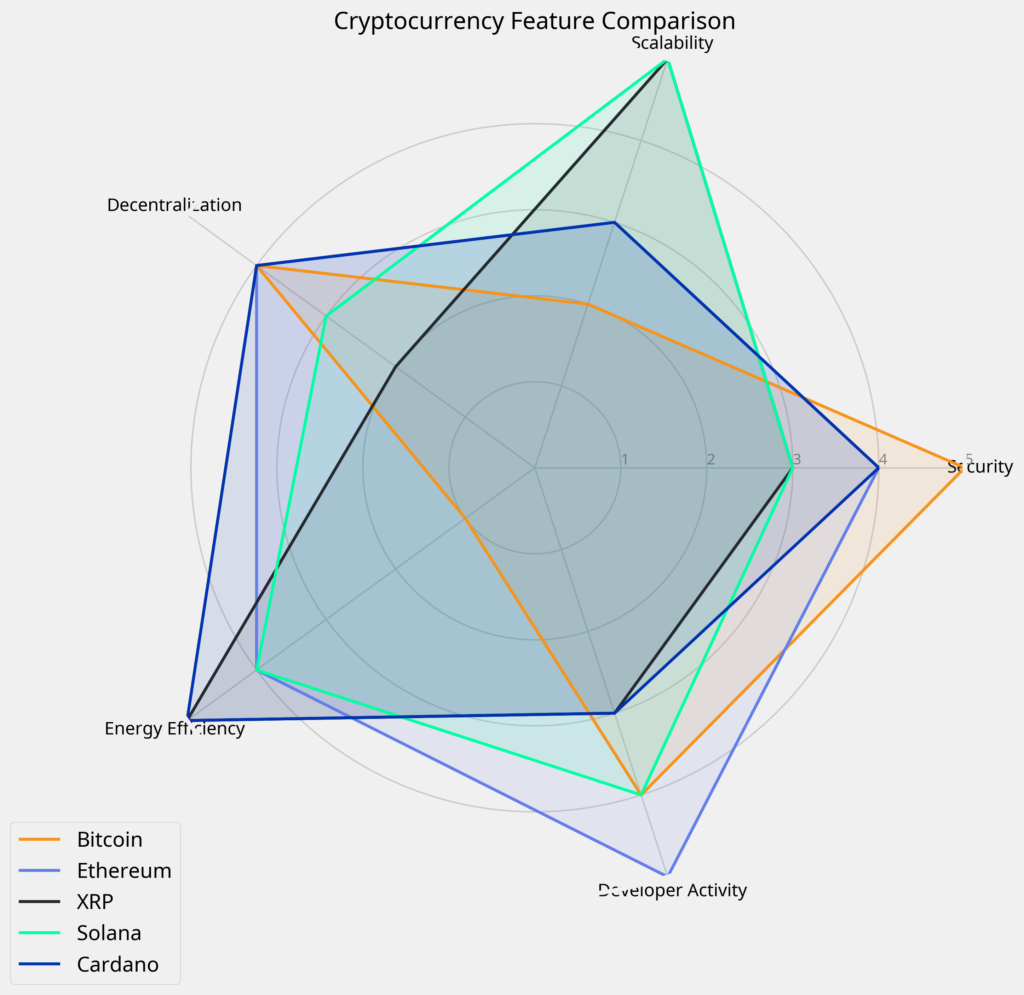
Each cryptocurrency offers distinct advantages:
- Bitcoin excels in security and decentralization
- Ethereum leads in developer activity and ecosystem breadth
- XRP offers superior scalability for payment applications
- Solana provides the best performance for high-throughput applications
- Cardano stands out for energy efficiency and methodical development
Future Outlook
Trump’s cryptocurrency policies signal a significant shift in the U.S. government’s approach to digital assets. By establishing the Strategic Bitcoin Reserve and Digital Asset Stockpile, the administration is positioning the United States as a leader in the cryptocurrency space.
This move may trigger similar actions by other nations. As Treasury Secretary Scott Bessent noted, “We’re going to move the cryptocurrency owned by the U.S. government to the digital stockpile… The purpose of the stockpile is responsible stewardship, it’s a place for safekeeping, it’s a centralized account under the direction of the secretary of the Treasury.”
For investors, these developments create both opportunities and challenges. The five cryptocurrencies highlighted in this analysis—Bitcoin, Ethereum, XRP, Solana, and Cardano—are well-positioned to benefit from Trump’s policies, but they each come with their own risk profiles and technical limitations.
The cryptocurrency market remains highly volatile, with Bitcoin experiencing significant price swings from $68,000 in October 2021 to $17,000 in October 2022, before recovering to over $80,000 in 2025. This volatility underscores the speculative nature of cryptocurrency investments and the importance of careful risk management.
Conclusion
Trump’s cryptocurrency policies represent a watershed moment for the digital asset industry. By establishing the Strategic Bitcoin Reserve and Digital Asset Stockpile, the administration has signaled its commitment to positioning the United States as a leader in this emerging technology sector.
The five cryptocurrencies examined in this analysis—Bitcoin, Ethereum, XRP, Solana, and Cardano—each offer unique advantages and face distinct challenges. Their inclusion in the U.S. government’s digital asset strategy provides a measure of legitimacy that may accelerate their adoption and potentially support their valuations.
However, investors should approach the cryptocurrency market with caution. The extreme volatility, regulatory uncertainties, and technical limitations of these assets make them suitable primarily for those with high risk tolerance and a long-term investment horizon.
Disclaimer
This analysis is for informational purposes only and does not constitute investment advice. The cryptocurrency market is highly volatile and speculative. The information presented here is based on research from reliable sources, but market conditions can change rapidly. Investors should conduct their own research and consult with financial advisors before making investment decisions. The responsibility for any investment decisions rests solely with the investor.